Friday, September 28, 2012

Conversions and De-conversions – It’s Science. It’s Magic


I spent the next seven years studying, teaching and researching physics.  It was an extremely active time in my life.  I met a whole new group of people, and made friends from all over the globe.  NMT is specifically a science and engineering university, and is not known as much of a party school.  I was extremely diligent in my studies, and I took them very seriously.  I could write several more chapters about my experiences in university, but since this Conversions and De-conversions series is specifically devoted to my spiritual journey, this chapter will be the last to cover those years.  While I spent about eight chapters describing my few years of religious fervor in Calvary Chapel, I will only write briefly about the long period of time I spent in University.  I did not forget about my Christianity entirely.  In fact, toward the end of my University years, I sorely missed my religious experiences, and craved to find a decent church congregation again.  But in the midst of my studies, I confess, Jesus had to take a back seat.

I learned firsthand how advances are generally made in scientific knowledge.  There are revolutionary breakthroughs, but these are actually very rare.  The accumulation of knowledge is typically a painfully slow process.  I believe that the romantic days of brilliant mavericks like Albert Einstein, who single-handedly overturn scientific paradigms and open the doors to new ones, are pretty much over.  These days, most scientific endeavors are the product of huge committees.  Major papers are authored by several, if not dozens of collaborators.  Formulating, researching, authoring and defending my masters thesis was a simple introduction to that process.

First, I found some anomalous data.  Actually, my research advisor found it for me, and told me that it would be something good to spend the next couple of years working on.  Without getting too specific into what this data involved, let’s just say that my advisor collected data from Star X for several years.  Star X behaved uniformly during most of that time.  Much interesting science was done on Star X because of those years of collected data, and its behavior was somewhat predictable.  Then, for some unknown reason, Star X acted unexpectedly, strangely, for about a month.  The data that was collected was anomalous.  It did not act as expected.  This is the point where scientists start licking their chops.  Scientists love anomalous data.  They love when things do not look as they expect.  It means that more important work needs to be done.  It sometimes means that something new lay out there, just waiting to be discovered.  At the very least, it means more funding!

The process is pretty straightforward, although it is arduous and slow.  First, I had to research a bit about Star X and other stars like it, and the known physics that they followed when they behaved normally.  This meant lots of trips to the research library to read hundreds of peer-reviewed papers in research journals.  This meant contacting other experts in the field from around the world, getting them interested in my work, and attempting get ideas and collaboration from them.

Then I would have to form a hypothesis.  What could possibly cause Star X to act the strange way that it did?  I would literally have to start with a guess, although a somewhat educated guess.  After hashing it out with some of my friends and professors, I would weed out most guesses, and stick to one or two of the ones that seemed most likely.  These became my hypotheses.  Then I would have to flesh these hypotheses out.  They involved some physics that I was not as well familiar with, so this led me to read books and papers slightly outside my field.  I would have to then model them with mathematics, and analyze these models by programming them into a computer.

I am mentioning all this, because this is one of the main lessons that I learned while attending University, and even one of the biggest lessons that I learned to apply to the rest of my life.  It is one of the lessons of critical inquiry that I was never taught before I attended University, that most of the people I knew are never taught, and a lesson that I am certain very few in Calvary Chapel ever knew how to apply.  The lesson was not specifically one of scientific inquiry, although that is important.  It was a lesson that my advisors and professors constantly applied to my research work, to each other, and one I finally learned to apply to my own work.  That lesson is this:

The way to knowledge is not to find reasons why a given idea is true.  The way to knowledge is to find reasons why the idea is not true.

That, in a nutshell, is my personal definition of critical inquiry.  The method seems absurdly simple, yet it is often counter intuitive.  Critical thinking is a skill that one must learn.  Often, people get an idea; formulate a hypothesis about something, then cling to it as if they were afraid to betray it.  But I discovered that reasons, justifications, even evidence, could be given for any idea.  Giving rationale for any position is not difficult, and this is evidenced by the countless conspiracy theories that their adherents are able to justify.  But gaining knowledge is not a process of propping up ideas then supporting them with any rationale.  Rather, it is a process of propping up ideas, then whittling away the dead weight of the unsupportable until a core of the idea, if that core exists, is left which cannot be as easily discredited.  Even then, this does not necessarily mean that the more solid idea that is left after critical investigation is true.  It is just a closer approximation to what is probably true.

The process of my graduate research was my life-lesson in critical thinking.  I had to present my research to graduate seminars, only to be questioned by suspicious peers.  I had to revise my ideas, throw away the fluff, and try to support what was left, then present again to another group of professors.  I once had my hopes crushed especially hard when I worked for a month on what looked to me like more amazing new data from Star X that nobody had seen before.  I talked for half an hour during a graduate seminar, showing slide after slide of my results and mathematical models to explain those results.  A simple question followed from one of the visiting astronomers.  “Did you check the uncertainty in your pointing?”  Ooops.  One month of work down the drain, but a lesson in critical inquiry learned for a lifetime.  I gave many seminar talks, and discussed several hypotheses and models to explain the strange behavior of Star X.  Most of the questions that I got from my critical peers were those that attempted to knock holes in my arguments.

To the chagrin of all the Creationist pamphlets and propaganda that I read in Calvary Chapel, I learned that the scientific literature is full of ambiguity.  I remember plenty of creationist sermons that laughed at the use of ambiguous language in scientific books, then pointed to the sure and solid foundational certainty of Scripture.  But scientific theories are not dogmas to be defended at all costs.  I had to get used to qualifiers like ‘probably”, “possibly” and “approximation”.  My old dogmatic world of religious bedrock conviction was replaced by a nebulous world of vague uncertainty.  Most of the scientific work did not result in solid, unquestioned answers, but in methodologies built on well-founded assumptions that led to slightly stronger hypotheses.  So I also had to learn a couple of other valuable lessons in critical thinking and inquiry.  I taught freshman math and physics for a couple of years, and in formulating and defending my hypotheses, I had to do what I told all my freshman students to do.  I must define my terms.  I must list and detail all my assumptions.  And I must describe and follow my methodology.  In other words, I had to show all of my work.  Much to my disappointment, most freshmen students were taught to circle their answers in a set of homework problems.  I told them that answers were important, but I was much more interested in how they got those answers.  I often asked open-ended questions with no easy answers in order to force my students to list all their assumptions, and describe their own methodologies.  I did not want to see a circled answer.  I wanted to understand what they were thinking to get that answer.  I believe that the critical thinker must hold methodology of even greater importance than answers. 

Several years of university work taught me to think in this way, but I also learned that this thinking process is often not what comes naturally.  Critical thinking is a skill that must be learned, practiced and willfully applied.  It is not always easy.  It is not innate or natural.  Critical thinking is not the same as common sense; in fact it is in some ways the opposite of it.  Critical thinking is typically destructive, not constructive.  These were lessons that I learned in University, but I am still learning new lessons in critical thinking to this very day. 

Critical thinking is a process that needs to be actively applied, and in the field of scientific inquiry, I did not meet a single person who did not understand this.  But for most people including myself, critical thinking applied only to natural processes.  It is a criterion that we knew well.  We could not factor God or the Supernatural into any scientific theory, because these are unknowable variables.  They are to be taken on Faith, so the scientific process must be one that must be atheistic.  This is not to say that the practitioners and scientists are atheists, in fact I am certain that most of the scientists I knew were not.  But their methodology cannot be one that includes any element of an unknowable Supernatural element.  We cannot replace a variable with a miracle, simply because this would tell us nothing of the natural science.  Likewise, science typically did not interfere with the religious or spiritual beliefs of my friends.  Most of the people I knew were not the purely rational thinkers who did not believe in anything without sound reason and logic.  No, my friends, all brilliant men and women, had fertile and imaginative beliefs outside of the laboratory.

I still clung to my Christian beliefs.  I had grown weary of, what I considered to be, the dead and impersonal ritualism of the United Methodist Church across from Campus.  I was certainly egalitarian, but I still never got comfortable with the female pastor who presided over that congregation.  Plenty of students and faculty attended that church, but I soon migrated to a small Baptist church outside of town.  I still never warmed up to that small congregation.  I felt like I needed some form of familiar Christianity in my life, but any time I got too close I was reminded of why I left Calvary Chapel in the first place.  I never could find a good balance on that high wire.

Outside of a few strictly rationalistic friends, everybody I knew had some form of supernatural belief.  Plenty of folks believed in alien visitors from other worlds.  Socorro, like nearby Roswell, had its own saucer crash legend, complete with impact crater.  Somebody went through enormous effort to build some kind of UFO landing pad on a nearby mountain west of town.  UFOs, and various beliefs of the inhabitants, were part of the culture in the desert southwest.  I confess that my imagination got carried away with one related item that Chuck Missler introduced me to, and that dozens of people on campus were also swept up with.  The infamous Face on Mars was a blurry photo taken of the surface of Mars by one of the Viking Orbiters in 1976.  Chuck Missler, in his sermons, often compared it to the Great Pyramids or Stonehenge, marveled us with its fantastic mathematical properties, and terrified us with the implication that somebody had to have built it.  But The Face on Mars was another lesson in critical thinking.  The famous photo of that mysterious face on another planet was blurry.  Pixelated.  Ill-Defined. 
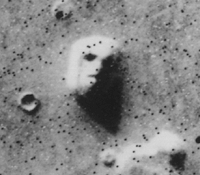

But when something that provocative lacks too much information, it leaves everything else to the imagination.  Books were written at that time, loaded to the brim with whimsical but fascinating speculation about The Face on Mars.  In 2001, another orbiter, Mars Global Surveyor promised another photo of the famous Face, this one promising much higher resolution.  A raw photo was promised to be uploaded to the Mars Global Surveyor website as soon as it was transmitted back to Earth, and a friend and I sat at the library computer as the photo rolled in.  That day I learned that definition and clarity, when applied to a mysterious and cloudy revelation, kills faith.


Plenty of my brilliant friends were adherents of astrology, tarot, and crystal vibrations.  These were not passing hobbies, but bordered on obsessions.  Some of my friends had a shelf or two full of books on these subjects, and held to their beliefs with uncritical devotion.  I continued my fascination with Reiki, and even though the mental source of its power was always obvious to me, I still wondered if there was not something more to the powerful experiences that I often felt.  I remember one amazing vision that I had during some meditation exercises.  I floated high above the Cosmos, which slowly undulated under me like an immense flag in the wind.  I was above the fabric of space-time.  I was a transcendent observer and could look from outside the fishbowl, just as if I were part of the Divine.  Then the Cosmos became bigger, or I floated too close to it, until I was swallowed up into it, and got lost in the immensity.  Had I been a religious ecstatic from another time, I can easily imagine myself as Enoch traversing the Heavens and learning the secrets of the Cosmos from the archangels.

Unlike the days when I was in Calvary Chapel, I did not scoff at the beliefs or others, or try to convert them to my own beliefs.  I was intrigued with Reiki, but I also asked plenty of questions about the beliefs in things like astrology and reincarnation.  I found the answers unsatisfactory, so I did not believe in such things.  It was as simple as that.  But I had learned that if I was to be taken seriously, I had to take others just as seriously, and it was just too easy to view the beliefs of others as crazy. 

I met one particular woman in one of my math classes, and we began dating.  After several months of dating this beautiful and brilliant Chemistry PhD candidate, she felt she could trust me enough to tell me a secret about herself.  Her secret came out slowly, in bits and pieces, over the next couple of weeks.  I only knew her on the material and physical realm of Earth, she told me.  But on another plane of existence, she was a warrior princess.  She fought trolls and monsters to protect her loyal subjects.  She could shoot fireballs of pure energy from the palms of her hands.

This was a bit much.  Was she kidding me?  Was this a stunt?  Was Allen Funt going to step out from behind the curtain with his hidden camera?

She also had a familiar guardian cat who served as her psychic advisor.

I never ridiculed her.  Never.  I had learned never to do that.  Instead, I asked her if I could see.  Since she trusted me enough to tell me, could I see and experience the things she did?

“Can I see your familiar cat?”

“No.  She is invisible.  But she is right there watching you,” she said pointing to the floor.

“Can you take me to your other world?  Can I see what you see?  Can I travel there with you?”

“No.  It is a place that you do not travel to physically.  You only get there through the astral realm.  You are not ready.”

I wanted to take her seriously.  What if she is right after all?  It would be beyond fantastic!  I would be one who truly bore secret knowledge and my life would never again be the same!”  But too many things that I asked about were invisible, or inaccessible, or beyond my understanding.  I was convinced that she was experiencing something, but if I were to continue to take her seriously, I would have to accept her by Faith alone.  I simply could not do that, and I had to confess to myself that she was simply deluded.  The experience of breaking up with her was extremely painful.  I felt like I had been trusted, and that I had betrayed her trust.  How could this intelligent, seemingly rational young woman hold these beliefs?  How could she cling to these beliefs, and drop out of a University PhD program rather than face her unbelieving, skeptical ex-boyfriend?

It was also around this time that I stumbled into James Randi’s book The Faith Healers in the university library.  Randi, a well-known stage magician and professional investigator, detailed his personal investigations into the world of Faith Healers.  Some of his favorite whipping boys were Peter Popoff, Ernest Angley and W. V. Grant.  These men who posed as itinerant evangelists were obvious conmen, who used stage tricks to magicians, to fool the needy into tithing money into their personal savings.  It said nothing about belief in a True God, but about conmen posing as God’s prophets, I reasoned.  I had never heard of Popoff or Grant, but I did hear of some of the other people in his book.  Oral Roberts was a well known Faith Healer when I was a child, and my mom had even owned a copy of his book on Seed Faith.  If we tithed, it was a sign to God of our faithfulness, and he would reward our planting of seed faith many fold!  That made perfect sense to me as a youngster, and Roberts was revered as a devout and holy man of God!  That childhood fantasy was shattered by The Faith Healers, in which Randi exposed Robert’s bogus claims of various miraculous cures and resurrections.  Katherine Kuhlman was another family favorite.  My mom once saw her on the traveling tent revival circuit, and my mom marveled that she saw Katherine Kuhlman lengthen a crippled man’s leg right before her eyes!  But Randi again showed how W. V. Grant performed the same cheap stage illusion.  Sure, I would not be fooled by such obvious chicanery by cheap suits like Popoff and Angley, but I figured that was because I had never heard of them before.  I knew Roberts, and I knew Kuhlman, both of whom were doing the work of God.  Yet, Randi lumped these well known paragons and models of my youth in with the rest of the crooks who lied and swindled in the name of God.  The Faith Healers was did not affect my faith in Jesus, but it did make me suspect that most of the preachers I knew in my youth were nothing but conmen.   What shocked me that most was that my family was fooled by these people.  We were intelligent people, yet we were fooled, and could be fooled again.  We did not know how to think critically.  Nobody ever taught us.  We were just taught to have Faith.

We all have the propensity to be fooled if we do not actively apply critical thinking skills.  I became friends with an elderly woman who was a retired music professor from Canada.  She moved to New Mexico with her beloved dogs because she loved the solitude of the desert southwest.  But one of her dogs got very sick, so she went to see a ‘healer’.  I noticed that my friends used the term ‘doctors’ for impersonal practitioners of western medicine, but ‘healers’ were more empathic of their patient’s needs and generally more non-traditional.  A woman certified in Reiki was a ‘healer’.  So when my elderly friend told me she was taking her beloved dog to a healer, I knew it would not be the vet.  After the visit, she asked me to listen to a cassette. 

“I know you are more skeptical than most, and you may think I am crazy, but I want you to listen to this recording.  I just need your opinion, because you are skeptical and I don’t want to make the wrong decision.”

“What is the recording?”

“I recorded the session I had with my dog and an inter-species translator.  She placed her hands on my dog, and told me the dog’s thoughts.”

Oh dear.  This intelligent, elderly woman, a retired professor who had traveled the globe, a woman who told amazing stories of her work in Africa with Jane Goodall in the 1960s, this otherwise rational human, took her dog in for a Mr. Spock style mindmeld.  But I did not ridicule.  I took her seriously.  I took the cassette and listened to it on my own.

What I heard was stunningly obvious manipulation.  The healer said that the dog was talking through her.  He does not feel good.  He ate some road kill.  He has an upset belly that will not go away.  He wants you to understand that he will be better but he needs a more sensitive diet.  My friend sometimes interjected with astonishment.  How could the healer seemingly read the mind of her dog?  Incredible!!

I told her I thought she was being had.  I advised her to proceed with caution, and take the sick dog to a vet.  I am impressed that she listened to me.  But all these stories that I am telling boil down to one of the most important lessons that I learned while in university.  Critical thinking is a skill.  It must be learned and actively applied.  It does not come naturally.  Even the most intelligent of us, even brilliant scientists and other educated people, can be fooled, in fact, are likely to be fooled if our guard is not up.  And there were plenty of people out there who knew this, and were ready to trick us into earning their trust, manipulating our emotions, and maybe even draining our pocketbooks.

In May 2003, I finally earned an M.S in physics and found employment in El Paso, Texas.  I was 39 years old.  I was still single, with no children, and ready to begin the next huge chapter of my life.  I had been saturated in the scientific world while living in Socorro, and I felt like I was stuffed to the brim with potential energy.  I was ready to apply everything I had learned to life, to a career, to my faith and to my future.  But I also felt somewhat empty.  I felt the call of my Spirit crying out to Jesus again.  I had not forgotten He whom I had reluctantly left on the back burner for seven years.  Jesus was my everlasting Savior, and I was ready to meet Him again.  I started looking for a new church in my new home. 

Previous Chapter
Next Chapter

Friday, September 21, 2012

Conversions and De-conversions - Symbolic Disguisings of the Truth


In May 2003, I defended my Masters Thesis in physics.  The subject matter of that thesis was one I had worked on during the previous two years.  It was something that I researched and thought about every day during that time, so I was fully prepared on the day of my defense.  I had become fully acclimated to the rigors of the scientific method, and the procedure by which scientists hope to inch forward, ever so slightly, in their pursuit of knowledge and truth.  I was very privileged to be the tiniest part of that process.  I was but a mere blip on the radar, and I was honored to be in the shadow of my professors and collaborators, who were most brilliant men and women I had ever met.  I had changed immensely since I had first enrolled at NMT as a 31 years old freshman in 1995.  I had taken the first steps toward becoming critical in my thinking, and understanding the importance of methodology.  I was immersed in the world of scientific inquiry and investigation, and the naïve religious beliefs of my youth seemed a million miles away.

No I was not an atheist.  I still considered myself a Christian.  I still believed.  In something.  What exactly I believed in during that time was a little vague, ill-defined, and evolving over the course of time.  I would not say that it was syncretistic.  I was not trying to combine all religious beliefs into a single true one.  I did not think that all gods were the same.   The only religious tradition that made any sense to me was the one that I was raised in, and the one I converted to in Calvary Chapel.  I believed in Jesus, of course.  And of course he died on the Cross as an atonement for our sins.  Yes, of course, he died on that cross and rose again three days later.  He was the All-Mighty after all.  But my old beliefs about an His literal ascension into Heaven – well, I knew far too much astrophysics and astronomy at this point to know that this post-mortem destination of Jesus could not be taken literally.  The disciples of Jesus are said to have watched Jesus float off of the ground and rise into Heaven.  The disciples peered into the sky to watch Him disappear into the clouds.  The person who wrote those Biblical scenes some 2000 years ago obviously thought that the abode of Jesus was in a place located in the sky beyond the clouds.  But I knew what was up there.  My research work and thesis was in astrophysics.  I had done work at the VLA radio telescope observatory, and had spent many evenings in the Etscorn Campus observatory just for fun.  I understood, better than any of the ancient Gospel authors, what actually comprised the heavens.  So where exactly did Jesus go when he lifted off the earth?  What was his real destination?  Somewhere in the cosmos?  Was he blasting through outer space until He reached his Heavenly Throne?  If not, where did He go exactly?  This small part of the Gospels, like so many other small parts of the Bible and of my Faith, retreated into the world of metaphor and myth.  Quite what these stories meant, I did not exactly know.  All I knew was that stories like this could not be taken as literal truth.  They were true, in some non-literal sense.  But again, I did not know what non-literal sense I could make of these things I knew to be still somehow true.

All I knew was that the Christianity in the literal and exclusive form that I believed in Calvary Chapel was wrong.  It was simplistic and willfully ignorant of too much science and heretical Worldly Wisdom.  The world was vastly more enormous and complicated than the Biblical writers could ever have imagined.  But at the time, I did not dwell on these problems too much.  I had other priorities in mind – like working on my Masters thesis, research and teaching freshman classes.

My way of reconciling myth and metaphor in my religious beliefs, and what I knew of physical reality came one evening when visiting a friend.  He introduced me to a VHS tape the he had on a shelf.  “You never heard of Joseph Campbell?  Oh, you would absolutely love him.  A whole new view of the world.  He has some very interesting ideas.  Why don’t we watch some if it!”  Yes, this is the kind of thing we did for entertainment in the tiny farm and university town of Socorro, New Mexico.  So I watched a bit of Bill Moyers interviewing Joseph Campbell, on the Power of Myth.  This was the first time I can remember hearing somebody compare, even equate stories from the Christian Bible with pagan mythology.  Campbell spoke endlessly on the mythology of the hero, and how the same hero-themes occur again and again in our mythologies.  These myths, I later learned, are the chain of literature and imagination that can be linked back to antiquity and beyond our earliest rememberings.  These themes bridge cultures and time, and somehow strike a nerve in all of us.  They are the same themes that occur often in literature – because they are the same themes that ultimately make a good story.  Campbell paid particular attention to the hero-themes in a story like Star Wars, and why we seem to resonate with these stories so well.  But these themes are also present in our mythologies and our religions.  They are even present in our Biblical mythologies and traditions.

Joseph Campbell was my introduction to comparative mythology.  This captured my imagination, but I dared not extend that too far into comparative mythology and religion.  Campbell did dare to do this, and I had never heard such potentially dangerous ideas before.  But I was not too shocked.  I had learned by this time in my life to not be so thin-skinned and ready to be persecuted as I was as a Fundamentalist.  In fact, it was somehow comforting.  By this time, I was fully aware that much of the Bible could not be taken literally as I had once thought.  I was at a loss as to how to reconcile my evolving Christian beliefs with obviously non-literal Bible stories like Adam and Eve.  But somehow, Joseph Campbell and his comparative mythology allowed me to admit that Adam and Eve was just mythology – but mythology with common themes like God’s love and justice, humanity’s faithlessness, pride, and foolish propensity to be deceived.  God could inspire the Bible, and use myth in His inspiration.  Myth was the way God could communicate these ideas of love, justice and redemption in a way that transcended all cultures.  Since myth contained elements and themes that were ubiquitous in stories and ideas, people could readily understand what was in the Bible as myth, but with deeper meaning.  Myth at its best, I came to believe, was just “symbolic disguisings of the truth”.

With this new rationale, I was able to admit that the Bible did indeed contain myth, but it was no less inspired by the Divine.  Some parts of the Bible, particularly the fantastic parts in Genesis, could finally be reconciled with my scientific knowledge.  And as long as I did not travel too far down the trail of comparative mythology, as long as I did not take comparative mythology to some of its ultimate conclusions, I felt confident that my Christian beliefs, although evolving, were still ultimately true.

I had never met a non-believer before I attended University, but I thought I knew a little bit about them.  I had been told by Pastor Skip that atheists lived meaningless and empty lives.  They were miserable people because they believed in absolutely nothing.  Skip told us from that pulpit that atheists should just end their misery, and by following their own rules of logic, should just go and kill themselves.  I had never met a real atheist before, so it was easy to demonize these godless people.  But after befriending one atheist, then another, and then several more, I had to admit that their lives seemed anything but hopeless and empty.  There was that cultural divide again.  Most of my friends were foreign students from places like Germany, China, Romania and Croatia.  When I found out that some of them were in fact non-believers, it was not because they advertised it.  It just slipped out, like when I asked one of them about her belief in the afterlife. 

“Heaven? Hell?  That is superstition.  When I die, I will die.  That’s it.” 

Yet they all seemed somehow normal.  I thought they were mistaken, and that surely our spirit would live on through eternity.  But they were not the raging, hateful maniacs that Pastor Skip told me they would be.  They were not miserable and hopeless; at least they did not seem to be.  Pastor Skip would often say that people without Jesus often seemed to be happy, but that was just a mask for public display.  We do not know their real spirits and true intentions, and deep inside they are all desperately lost, and seeking for God to fill the aching hole in their hearts.  Pastor Skip constantly warned us about the hypocrisy of non-believers, but I grew tired of imagining that behind closed doors my non-Christian friends were actually depressed, lost and miserable people, and I grew tired of imagining that I knew their hidden but true state of conscious hopelessness.  Pastor Skip confessed that we did not know their secret thoughts, but he went on to tell us what they were!  According to him, not only all Christians, but only Christians, had fulfilled and purposeful lives, but I came to understand that this simply was just not true.  I had been as fervent a Christian as I could be, yet I had to leave such exclusive beliefs behind for my own sanity.  At the same time, these non-Christians from all across the globe were certainly not so miserable that they would be better off committing suicide.  How dare Skip Heitzig!!  He had no business to tell these fine friends of mine or anybody else to go and kill themselves!  What in the world is wrong with Pastor Skip?

The further I got from Calvary Chapel, the more I discovered, little by little, that nearly everything Pastor Skip told me was false.  Just wrong.  Of course he did not lie. I thought, he was just ignorant of the facts.  All his thoughts were just tainted with his own religious paradigm that he could not think outside of.  He was still, underneath, an upstanding and moral man.  But at the same time I could understand why many Christians were reluctant to send their children to a public university only to be exposed to subversive ideas, cross-cultural pollination, and contrary views.  It could do nothing but puncture insulated and untainted naiveté.  Knowledge was dangerous, just like it was symbolized in the myth of Adam, Eve, and the tempting, powerful and corrupting fruit of the Tree of Knowledge.

Previous Chapter
Next Chapter

Friday, September 7, 2012

Conversions and De-conversions - Gone was the old grey stone


My first semester astrophysics professor lectured in front of 25 of my fellow students.

“What wavelength of solar radiation reaches Earth’s surface with the least amount of attenuation?  What wavelength is the least scattered or absorbed by the atmosphere?”

“About 550 nanometers,” answered one of the students.

“That is right!  550 nanometers corresponds to the green portion of the electromagnetic spectrum.  The light that we perceive as green is the light that is most efficiently transmitted to Earth’s surface.  That is why leaves appear green.  And the human eye also has its peak sensitivity at 550 nanometers!  Our eyes are more sensitive to green than any other color.  Coincidence?  Not at all.  This is evidence of …”

I had heard this before.  Chuck Missler used to stand in front of a crowd of hundreds in Calvary Chapel and give endless peculiar examples like this as evidence of obvious design by our loving Creator.  How is it that possible that our eyes could possess peak sensitivity at the optimal wavelength of solar irradiation?  How could the human eye possibly know where the sun would shine brightest?  Chuck Missler would say, “This is evidence of God’s handiwork”.

“This is evidence of Evolution by Natural Selection,” said my professor.  “The mechanism is amazing.”

I have mentioned several times in this story that I have always accepted Evolution as the best and most accurate explanation for the diversity of life on Earth.  I never told anybody in Calvary Chapel about my belief in the Theory of Evolution via Natural Selection.  Evolution, as I understood it, made perfect sense to me.  Evolution was intuitive to me, as the logic of it was gleaned from all the hikes and exploring of my youth, and witnessing firsthand the geology and climate of the vast desert.  It made more sense to me than the literal belief in a first man named Adam, and him naming all of God’s creatures.  True, I did believe the Genesis story because I had to as part of my Christian belief, but I always assumed that there was some non-literal or allegorical explanation behind the Biblical account, and I left it at that.  I did not explore the problem further, not because I feared the story would be debunked, but because it just seemed like an unsolvable problem, and I did not want to waste time wrestling with Christian issues that were peripheral to the central Gospel of Jesus Christ.  I also worried that becoming sidetracked by angels that danced on pinheads would become unnecessarily divisive within my Christian community.

Yet my belief in Evolution, as much as I accepted it, was immature before I enrolled in college.  Enrolling in a science and engineering university forced me to think about these scientific issues in a way that intruded uncomfortably on my religious beliefs.  I could not simply ignore Evolution like I had in the past.  Being confined in a science and engineering university forced me to confront it in a way that was sometimes a little too uncomfortable.  The implications of the Theory of Evolution via natural selection are earth-shattering to any person who believes that humans are special creations of God, and distinct and separate from the animal kingdom.  Many Christians who accept Evolution, like I did, have to sidestep or even ignore these implications in order, I now believe, to cling to their beloved Faith.  I just accepted Evolution without fully understanding it, and did not dissect it fully enough to discover the problems that it would give to my Faith.

Christians have every reason to either dismiss Evolution as a fraud, claim it is without scientific support, or tentatively and grudgingly accept it only to brush it and its uncomfortable ramifications under the rug.  When my professor fiendishly told us students that the human eye is most sensitive at the same wavelength as the peak solar irradiance, I could just as easily have claimed that it was not due to Evolution, but was instead evidence of the exquisite design of our loving creator.  God made our eyes sensitive in the green portion of the solar spectrum because God made the Earth’s atmosphere transparent to that part of the solar spectrum.  How else could we explain the interlocking serendipity of the otherwise unrelated human eye and a sphere of plasma 93 million miles away?

Despite my belief in the Theory of Evolution, and despite living in a university environment that stressed methodology over certainty, my brain still protested with echoes of Evangelical Christian propaganda.  To think that Evolution could produce us, in our complexity, out of nothing but a stew of chemicals, and with nothing but blind chance, was seemingly impossible.  Pastor Skip, who just repeated to us clichés that he had heard, said that it was like assembling a 747 jet airliner with a tornado rampaging through a junkyard.  The eye, I was told, was too complex to assemble by chance and out of multiple inter-dependent parts.  I still have an old sermon on cassette by Henry Morris, father of Flood Geology and author of The Genesis Flood, in which he claims that something as complex as the eye could not form by random mutations.  Each of perhaps hundreds of mutations would have to be independently directed to the benefit of eyesight.  The mutations could not form gradually from these random mutations over millions of years, so I was told by Henry Morris.  What good is half an eye? 

Out on one of my multiple geological field trips in the desert, rock hammer in hand, I asked one of my friends about some of the problems that I had understanding Evolution.  More precisely, I asked him about problems that Evangelical Christianity told me I should have with Evolution. 

“Like what?” he asked.  I gave him the problem of the existence of the eye that Henry Morris told me was unsolvable through the blind chance of Evolution.  After my friend solved the problem of the eye after about one minute of explanation, and after he scanned the harsh desert that we hiked through and reminded me about the natural, environmental pressures that drive natural selection, I never again thought of Henry Morris, young earth creationism, or flood geology as viable or believable scientific theories about our natural world.

Pastors Skip and Chuck, indeed nearly everybody I knew in Calvary Chapel was convinced that Evolution was not only wrong, but also a willful deception.  A lie.  Evolution was an unproven theory, they said, that people who hated God clung to in their desperation to deny His existence.  ‘Evolutionism’ was viewed as an alternate religion to Christianity.  Most of my friends back in Calvary Chapel did not think that heathens were deluded by the faulty evidence for Evolution, rather they believed that these heathens used Evolution as a smokescreen to outwardly deny what they inwardly knew to be true – that Jesus was Lord, and would be their ultimate judge.  Heathen Evolutionists were deluding themselves because of their hatred toward God.

This was emphasized when a special guest visited the New Mexico Tech campus for a free lecture.  Phillip Johnson, widely regarded as the father of the Intelligent Design movement, visited our campus and spoke to a packed auditorium.   I have to give him credit for his courage.  He spoke to an auditorium full of students, professors and scientists about the myopia of their methodological naturalism.  Surely, we must supplement our instruction of Evolution with at least the possibility of a Designer.  Since Evolution alone cannot possibly explain the complexity of the biological cell, or the self-aware mind in the human brain, we need to consider that there is some Purposeful Mind at work behind the biology.  I had never heard of Phillip Johnson before, but I had seen his book Darwin on Trail in the church bookstore, and I knew that he was an Evangelical Christian.  Although he purposefully never mentioned God, Jesus or the Bible in his public lecture, he otherwise spoke just as Chuck Missler would speak to a Sunday morning congregation.  I knew damn well that ‘Designer’ was just a euphemism purposefully chosen for a secular audience.

After the lecture, Johnson took questions.  One of the biology professors came absolutely unglued.  She stood and pointed at him, doing her best to control her anger.  “How dare you come here and accuse us of intentionally hiding data!  I do this for a living!  I devote my life to this!”  With that notable exception, most of the professors stayed quiet until they walked into the foyer.  From there, I heard plenty of snickers from the Geology department.  “I can’t believe that guy.  He thinks we are in a conspiracy to hide damning evidence against Evolution.”

One by one, the stories from the Bible that I had been taught, since childhood, to take as literal truth, were crumbling into mere fables.  Adam and Eve?  I had always taken that as some sort of metaphor, but pondering Evolution proved it to be nothing but myth.  Noah’s Ark?  Geology and physics demonstrated this story to be impossible if taken literally.  I especially remember the insight I felt thinking about the origin of the rainbow.  Rainbows are formed due to the natural refraction of light through the natural prism of water vapor.  Did the refractive properties and the laws of optics not exist before God formed a rainbow for Noah as a sign of His promise?  Absurd.  The deconstruction of my literal belief continued.  There was no ice canopy that covered Earth to give it a universally ideal climate.  A comet did not shatter the ice canopy, did not create the Deluge, and did not cause the first rain and thus the first rainbow.  This was all ad-hoc speculation that had no scientific basis.

On and on it went during my years in University.  Diverse languages did not originate at the Tower of Babel.  People did not live in excess of 900 years.  Evolution via Natural Selection was only a controversy within Christianity.  The controversy did not exist outside the walls of the Church.  Men did not escape death by being escorted to Heaven in a flying chariot.  For that matter, Heaven was not in the sky or anywhere ‘up there’.

The Red Sea did not part at the stroke of Moses’ staff, and the Israelites did not escape the Egyptians on dry ground.  There were no supernatural plagues to strike the Egyptians.  I supposed that the fantastic numbers of Israelites were exaggerated a bit, and that there were natural causes to all the ‘miracles’ of the Exodus.  However I figured that God was the moving force behind all these events.  The Egyptian chariots may have merely gotten stuck in the marshy mud in their pursuit of their Israelite slaves, but God was the one responsible for placing the mud there in the first place. 

Nearly all of the miraculous elements of the Bible were debunked in my mind.  But somehow, I still believed.  I just downgraded the miraculous to something more like the natural world that we observed.  Unbelievers claim that they never see the miraculous hand of God in the modern world, scientific, naturalistic world.  But, I figured, they did not understand that the hand of God was actually everywhere at work in the world, we just had trouble recognizing it because it was not the fireball from heaven that we were expecting.  The mundane world only operates through the Will of God, and every event occurs only through His providence.  In that sense, everything is a miracle.  It is only in hindsight that we look back, and we can link the events together that brought us into this special place.  How was I fortunate enough, I of all people, to find myself in a University?  Well, I could look back at the various events that happened previously in my life, not all of them pleasant, which brought me to the enviable position that I was currently in.  How can that be explained away?  How can all those people and events come into my life, to place me in this position today, except by the divine Grace of God?

My criticism of the miraculous in the Bible stopped at Jesus.  This is where the Bible remained untouched.  Jesus was God on Earth.  He had ultimate faith in His Father, more Faith than any mere human could muster, so He was able to perform His miracles, as evidenced by the eyewitnesses who wrote the Gospels.  Jesus was, so to speak, too hot for me to touch.  How could we have a redeemer of mankind who was not able to also perform miracles?  I was able to demystify almost the entire Bible as stories or legends or products of their time, but not the Gospels.  That was hitting too close to home.  Instead, my growing non-literal belief in Scripture assured me that I was not actually losing my Faith.  Far from it.  I was just growing more mature as a believer.  I was becoming educated and my beliefs more, I believed, sophisticated.  I no longer needed the strict literalism required for childish belief.

Somehow all disciplines, whether scientific, historical, or religious, like my Christian belief, converged and harmonized into some ultimate Truth.  My professors were not lying when they said they had evidence for Evolution.  The Theory of Evolution was the best model that they knew of to explain the evidence that they collected.  Where did this leave Pastor Skip back in Calvary Chapel?  The conspiracy theories of Chuck Missler or the flood geology of Henry Morris?  The pastors and teachers of my youth in Cape Baptist Christian School? Pastor Jack of New Hope Church?  Even my boyhood religious instruction from the fire-breathing Grandpa Wagner?  None of them were lying either.  They were all presenting truth as best as they understood it, but all in different ways.  They all loved Jesus, and they all accepted the Gospel in ways that they understood.  Jesus met them where they were at their own unique perspectives.

Most of my friends at New Mexico Tech were international students.  During my years in university, I had more friends from Asia and Europe than I did American friends, and I loved learning about their differences in food, music and culture.  But in order to do this, I had to become inclusive in this new environment of vast cultural and religious ideas.  I had to accept scientific evidence, and somehow incorporate it into my religious beliefs.  I no longer preached or witnessed to my friends, and I no longer felt any pressure or guilt for not witnessing.  I can only think of one exception to this.  I remember one evening in the first year of university career, while discussing religion with my girlfriend B----, I decided to use the C.S. Lewis Lord Liar Lunatic argument that I had learned so well from Pastor Skip.  I was not trying to convert her, since she always claimed to be a Christian, but I just wanted to get her reaction to an apologetic argument that I knew her mainline church had never exposed her to.  I recited to B---- most of the words of Jesus from John chapter 10.  From memory:
…My sheep hear My voice, and I know them, and they follow Me.  And I give them eternal life, and they shall never perish; neither shall anyone snatch them out of My hand.  My Father, who has given them to Me, is greater than all; and no one is able to snatch them out of My Father’s hand.  I and My Father are one.
 “Does a normal human say things like this?” I asked B----.  “Are these the words of a merely good man, or a sane human?”  B---- gave me a look that I was used to seeing after giving apologetic arguments.  She probably wondered if mine were the words of a normal or sane human.

I confess this inclusiveness was sometimes a little uncomfortable for me. I occasionally attended a United Methodist church across from campus.  I knew nothing of this particular Christian denomination, but I knew it was some form of Christianity, even though I knew it was a form of Christianity that the likes of Calvary Chapel despised.  I did, however go because the options were slim.  New Mexico Tech is in the tiny town of Socorro, NM and there were few churches to choose from.  There was no Calvary Chapel, but I figured that was just as well.  I did not want to go there anyway, or to the town’s only Baptist church.  I had my fill of literalism and the guilt that came with it.  I was not about to go to a Catholic church.  This pretty much left the United Methodist as the only option left to me.  But I could not attend regularly.  It was most difficult for me because of the female pastor at this United Methodist Church.  I could downgrade the miraculous to legend.  I could be inclusive as far as I felt the Bible would allow me.  But accepting a female pastor was ultimately too difficult.  Couldn’t these supposed Christians see that allowing a female to pastor a church was in direct contradiction to the Bible, for instance 1 Corinthians 14:34-35?

Despite these reservations, I had to admit that I had left Christianity as I knew it.  I was still a Christian who had to accept the physical world that I was learning so much about.  I could not accept that people who did not believe exactly as I did were lying about their convictions, or that anybody was being deceitful.  I became a generic, liberal Christian.  And again, I believe that I found myself in a place that many Christians find themselves stuck in when they are forced to leave some kind of religious fundamentalism.  I did not criticize my beliefs to the point where it cut too deep.  Of course I was still a Christian.  Jesus was my still Savior and I believed the Bible to be the Word of God.  But I admitted that there was much that I did not know, but somehow, someway I knew it was still all true.  And I left it at that.

Previous Chapter
Next Chapter

Friday, August 24, 2012

Conversions and De-Conversions - Awake, My Soul, And With The Sun


The five years that I spent in Calvary Chapel undoubtedly changed my life.  Calvary Chapel taught me that I was worthless, corrupt and wicked in the eyes of God.  I was utterly powerless to do anything from my own strength.  I was a failure as a human being.  My mind was the product of corrupted and sinful flesh, and was sure to do nothing but lead me astray.  My feeble works were folly, and my pathetic wisdom was foolishness.  The World in all its lustful glory was thoroughly damned, and it could offer me nothing but one-way ticket straight to Hell.  Calvary Chapel taught me that we put ourselves in this miserable situation, and we had nobody to blame but ourselves for God’s condemnation.  Everybody I knew, everybody I loved, everybody who I cared anything at all for, was doomed.  We were all born to be damned.  Almighty God provided only a single provision for our deplorable condition, and I thanked God everyday that He had chosen me according to His all-beneficent providence. 

I was certain that I had my Heavenly salvation, but I could not stop grieving over all those who did not.  Calvary Chapel forced me to accept that the heathen deserved their own pitiable reward, and the force of that heavy burden weighed mightily on my soul.  I had to believe that God was infinitely wise, infinitely just, and that the damnation stored for those I loved was due to their own willful and wicked rebellion.  I could not believe at the cost of my own sanity, it but I had to believe it.  Calvary Chapel taught me that God was infinitely wise, loving and just, but it brought me no joy.  I reacted to my Christian beliefs as if the all-loving Ruler of the Universe was an insane, jealous, capricious, all-powerful monster, who dangled each of us, as Jonathan Edwards once said, over the Fires of Hell by the slenderest wisps of thread.  All secondary beliefs had to conform to this one primary dogma.  If we were destined for suffering and damnation, it was not because God willed it, because God is infinitely just.  It logically followed, therefore, that the fault for our damnation lied with us.  God’s creatures ultimately got the blame for all suffering that they inherited, while God Himself received all the credit for any good that they happened to experience.  Nothing good proceeded from us tragic humans.  I was a worthless, wretched sinner.  God was to receive all glory.

  I gave my life to Jesus in 1988 because I was a miserable, joyless wreck.  I attended Calvary Chapel because I wanted to worship my Savior Jesus, learn more about Him, do good for others, and try to give my life some purpose and direction.  I left Calvary Chapel after five years, more miserable than ever, but in a way that was different from before I attended.  I was no longer drinking my sorrows away like I was before my conversion, but I nonetheless felt like my humanity was stripped from me.  Everything in those five years was focused on Jesus.  I could do nothing good of my own, and I had to give it all up to Jesus.  Jesus had to be the focus of every aspect of my life.  I could do nothing without His guidance and direction.  Idle moments had to be spent in His service.  I read and studied my Bible, I prayed, I witnessed, I ministered, I worshipped.  Everything was Jesus.  Jesus.  JESUS JESUS JESUS JESUS JESUS JESUS JESUS.  I still loved my Jesus, at least I thought I did, but He never gave me any isolation.  He was a stalker.  He was driving me crazy.

With this one-dimensional mindset that was forced on me, my self-esteem spun straight into the toilet.  Anything in my life that I gave any worth to was nothing but a puppet controlled by the mere whim of a silent deity.  When I prayed to Jesus for comfort, the silence that He returned to me was louder than ever.  I felt alone, I was wracked with guilt, and I fought the conviction that I was a worthless sinner in the eyes my perfect God, and any good He saw in me was due solely to His own worth.  I was evil, corrupt, and superfluous to my loving Jesus.  I was just so much chaff for the fire.

I left Calvary Chapel soon after I returned from my Hurricane Andrew mission, mainly for my own sanity.  The stifled mindset that Calvary Chapel was forcing on me was unbearable.  At the time I did not know exactly what was wrong, but I desperately needed a change.  I did not leave Calvary Chapel because I no longer believed.  I was not yet a critical thinker.  I did not question the historicity or veracity of the Bible, the deity of Jesus or any other central tenet of my Faith.  God was still sovereign.  Jesus still died for my sins.  I cannot say that I lost my faith.  I still believed everything I was taught.  I just needed a break from a life devoted totally and exclusively to Jesus and spiritual matters.

This was my state of mind as a Christian in 1993.  Upon leaving Calvary Chapel late in that year, my self-esteem immediately improved.  I do mean immediately.  I did not return to drinking and partying, as so many paranoid sermons at Calvary Chapel assured me that I would.  Instead, I focused more on my night classes at Albuquerque TVI, particularly physics and math.  I stopped spending time only and exclusively with my church friends, and surrounded myself with a more diverse group of people than I had ever done before.  The natural curiosity that Calvary Chapel squelched was finally awakened in my mind.  I returned again to my first love of reading, and I was suddenly unafraid to read books that would have been discouraged at Calvary Chapel.  I don’t know exactly what happened in my psyche in the immediate years after I left Calvary Chapel, but my whole outlook blossomed.  It may be that after three false starts of trying to grow up, the first attempt through the military, the second through alcohol and parties, and the third through Jesus, that I had finally found something that worked.  I finally found a simple maturity, and a blossoming self-esteem, neither of which I had ever possessed before.

I turned 30 years old in 1994.  If my high school years were the worst years of my life, I can honestly say that the years between 1993 and 1996, the years immediately after I left Calvary Chapel, were easily the best years of my life.  Instead of focusing every aspect of my life on Jesus, everything I learned felt new and fresh.  I spent more time at Albuquerque TVI.  I read, I explored, I studied and I learned.  Most importantly, I began meeting a wide and diverse array of people, some with unusual and contrary opinions.  For the first time in five years, I listened to my new friends without the ulterior motive of trying to wedge the Gospel of Jesus Christ into the conversation.  It was liberating.  Christians sometimes accuse apostates of leaving the Faith because they want to be free from God’s accountability.  I must confess that in my case at least, they had a point.  While I would not have called myself an apostate at the time, in fact, I still considered myself a Christian, I needed to be free from the ever accusing judgment that God burdened me with.  I never felt more free than I did in those few years immediately after leaving Calvary Chapel, when I finally learned to live without Him invading my every thought and judging every action.

For the first time in my life, I had enough confidence in myself to become romantically interested in women.  Outside of a single high school fling, I never dreamed that any woman would ever be interested in me.  Women generally left me aloof and intimidated, and I rarely talked to them.  I never questioned my own sexuality; after all, homosexuality was an abomination.  Dad asked me more than once if I was gay.  I think he was a little concerned.  I assured him that I was straight, but unconvinced, he asked me on several occasions to join his Mormon congregation on some Sunday morning, and he would introduce me to some nice, young women that he knew.  No thanks.

It is amazing to me, looking back nearly twenty years ago, how the simple act of not attending church had such an impact on my self-esteem and general outlook on life.   Perhaps another factor that played at this time were the night courses that I was simultaneously taking at Albuquerque TVI, and the interaction that I had with the wide and diverse mix of people that I met there.  It may also be that at this time I was discovering that, to my amazement, I was exceptionally talented at something that I had earlier in my life found to be impossible.  While Christianity taught me that my total intrinsic worth was nothing outside of Jesus, and that absolutely no good thing could ever come from myself, my night classes taught me that I could understand and creatively apply mathematics, that terror of my high school years, to a level that I never before dreamed possible.  Calvary Chapel, in particular, constantly stifled my own worth and merit, so I guess it should be no surprise that my self-confidence blossomed the second after I finally left that particular Church.

I continued to work as a cook and waiter in Albuquerque when I was finally able to gather up enough courage to ask one of my waitress co-workers on a date.  She was the first of several that I casually dated at that time.  I was not too romantically involved with any of these lovely women, and I was not yet interested in pursuing a relationship.   I was just thriving in my new, guiltless freedom, and I was learning new perspectives on life like a dry sponge thirstily soaking in water.  I was constantly meeting new people, and I was excited to see for myself how they approached life.  While I never felt the need to adopt any new lifestyle, neither did I feel compelled to preach to anybody and convict them of their sinful ways.  I purposely let that part of my Christianity wither and die.  I figured that I could always come back to Jesus, but I for the time being I needed to remove myself from Calvary Chapel, the only conduit for Faith that I then knew of.  In the meantime, I thrilled in exploring, growing and maturing.  I cannot emphasize enough how those Renaissance years between 1993 and 1996 were the best years of my life.  I was too close to the trees to notice that it was also the beginning of the end for my Christian Faith.  The chisel was applied to the foundation, and it slowly, speck by speck, chipped away.

Calvary Chapel taught me to be aware of ‘cults’.  I needed to avoid those beliefs which had a resemblance to Christianity, but which denied the sole divinity and salvation through Jesus Christ.  Most people that I met during this time claimed to be Christians, but very few of them actually fit my narrow definition of what a Christian actually was.  Not that any of that kept me from learning more about them.  I dated a woman who was fascinated by UFOs, crop circles and traveling to places of harmonic convergence.  She had photo albums and binders full of catalogued photos and articles about these astral encounters.  I never criticized her, but I wanted to learn more.  I wanted to understand why she believed these things as strongly as she did.  She was also a licensed Reiki therapist.  The Fundamentalist in me would have condemned her as a heretic and her beliefs as demonic cultism.  Instead, I asked her to give me a session.  I wanted to experience what she did.  I lied down on my bed and she placed her hands on me, explaining that she was projecting or channeling some kind of energy through herself and into key connection points of my body.  I had heard of such silly things before, but instead of dismissing her as a nut, I decided that I wanted to take her seriously, and experience what she experienced, and to see if I could immerse myself into her alien belief.  And after several minutes of concentrating on her hands that I felt on my body, I could actually feel her hands sink deep into my chest, and bury into my flesh.  If I allowed myself into her world, and had momentary Faith in her Reiki discipline, I could literally feel her burning into my bosom.  It was a powerful sensation.  While I enjoyed exploring what she held to be sacred, I also secretly understood it to be a mind game.  I had to allow myself to let it happen, just like a therapist’s patient can be hypnotized by the power of suggestion only if the patient is willing.  If I stopped concentrating, the spell was broken, and I was instantly whisked back into the mundane world, and I could feel her mere physical hands resting only on the surface of my physical skin. 

It was then that I realized all those emotional rushes of love that I felt by the power of the Holy Ghost, well, they might have also been just brought on by the power of suggestion too.  I only felt the physical embrace of God during intense moments of ecstatic worship, and I had to allow for the sensation to take place.  They never took me by surprise.  Of course I still believed in God.  But I was not going to allow myself get so emotional over worship again.

I became a master of, what I later learned was called, cognitive dissonance.  I wanted to place the beliefs of my friends into one part of my brain, experience them, and try to understand them, only to ultimately see the mind game inherent in them.  I could see the danger of doing this, because it is only natural to extend that kind of criticism to my own belief in Jesus.  There was a reason why Calvary Chapel wanted so desperately to keep me ignorant.  But I left my own precious beliefs in another part of my brain that was safe from self-reflection. 

I have a strong suspicion that most people who leave Fundamentalist Christianity stay stuck at this point in their escape.  I did not reject my former beliefs completely.  I still believed in God, Jesus, Divine incarnations, Heaven, Hell, Divine Judgments, and all the rest.  I had to meet other people and learn other perspectives to understand that, well, Jesus might not be the only way to Salvation after all.  How could God damn all these naïve, sincere people?  I thought, maybe, perhaps, God did allow many paths to Salvation after all.  And this, I do think, is where most people who escape Fundamentalism leave it.  They do not take the next few crucial steps that I had to make into total non-belief and de-conversion.   I did have to take a few more steps to get to that point, but those steps had to come in their own time.

The next crucial step in my de-conversion was that I fell in love.

In May 1994 I met B----.  How do I describe this woman without allowing my writing to descend into a pool of emotional mush?  This is a story of my spiritual journey, and she is a huge part of that journey, even if indirectly.  B---- came into my life in that crucial time after I left Calvary Chapel, a church that encouraged Christians to be obedient and ignorant followers of unquestioned dogma.  B---- was the first person I ever met who dared tell me to shake those chains from my mind.  She proposed the frightening concept of doubt and questioning.  “Question Everything!” she would tell me, and it was a lesson that took me over a decade to fully understand.  She taught me to believe in myself.  She was the only person I had ever met up to that point, parents included, who convinced me that I was good, that I was smart, and that I was interesting.  B---- introduced me to science, to life, to art, to all sorts of worldly pleasures and pursuits that were the complete anathema of my Christian heritage.

At the time, B---- was studying chemistry at the University of New Mexico, and loved my enthusiasm for math and physics.  Even though our relationship only lasted three years, I will always remember B---- and how much she taught me.  Some time ago, I wrote a short story on this blog about the time B---- took me to the University of New Mexico library, and I stood dwarfed amid shelf after shelf after shelf of bound research journals.  “There is so much here!”  I exclaimed.  “There sure is.  This is the Wisdom of the World!”  The Wisdom of the World was contained in this new sacred space.  This library had so much content, and so much to digest, and the platitudes and condemnations of Pastors Skip and Chuck just paled in comparison.  Pastor Skip taught me to beware of the Wisdom of the World, but surely he was wrong about that.  I could not wait to dive in!

B---- accepted my Christianity, and constantly affirmed that she was also one.  Her family came from a long line of Methodists back in Virginia, and her family was in regular attendance.  I had been warned by Calvary Chapel about ‘Sunday Only’ Christians.  She never answered an alter call, and certainly did not understand the concept of Salvation through Faith alone.  But the thought of preaching to her just seemed absurd at this point, although I came dangerously close a few times.  Some of the books she asked me to read were certainly bizarre and heretical, but I also found them exciting and mind-expanding. 

One of the first books that B---- gave me was James Redfield’s new blockbuster The Celestine Prophecy.  I had to read it, she said.  I honestly do not remember much about the book, except that it was a story about an explorer traveling to exotic locations in quest of certain ‘spiritual insights’.  It was left ambiguous whether this story was true or not, but I suspected it was not when, at the last page, some characters literally vibrated themselves into pure energy.  “What did you think about the book??” B---- asked enthusiastically.  “Well….” 

B----- always seemed to flirt a little too close to ambiguous New Age western-eastern spiritual jumble.  But she insisted she was a Christian, and I was madly in love, so what did that matter?

Other relevant books she gave me included Fritjof Capra’s The Tao of Physics and Zukav’s The Dancing Wu Li Masters.  These books attempted to describe how Eastern religions such as Hinduism so neatly correlated to modern particle physics.  I read these books, but I remember almost nothing about the religious or spiritual aspects.  But their descriptions of the bizarre world of quantum physics fascinated me, and the natural physics captured my imagination.  Several books on the mathematical discipline of chaos theory, which seemed to be almost trendy in the early 1990’s, put me deeper into the world of math and physics.  Instrumental here was James Gleick’s popular book, Chaos.  Chaos theory, which could not be fully studied until computer power had evolved to a suitable level, explored the idea of infinite amounts of information contained in finite spaces, and constructed with only a simple recursion formula.  Even the tiniest perturbation in a formula’s initial condition would add a new set of infinite amounts of information.   Chaos theory and quantum mechanics overwhelmed me with their ambiguous power.  The world was more enormous, more vague, and more unpredictable than I ever imagined.

I also re-introduced myself to the work of Isaac Asimov.  My high school years were filled with his science fiction novels and other forms of escapism.  I picked up from somewhere his enormous, three-volume book, Understanding Physics.  This book fascinated me like no other.  I read it in bed, in the bathtub and in my break area at work.  I read it at every spare moment until I had it finished.  I started at page one, the most basic forms of mechanics, and did not stop until his discussions of general relativity and quantum physics at the end.  I was enthralled.  Asimov presented physics as a historical overview, how the simplest steps in understanding the natural world was started by the ancients, and how each new discovery was built upon the previous foundation.  I particularly remember Asimov’s discussion of Mendeleev, and his construction of the Periodic Table of the elements, to be incredibly fascinating.  Atomic elements could be predicted to exist, based on the periodic nature of the already discovered elements.  Predictions were made, experiments were conducted, and the elements were discovered, with the properties that they were predicted to have.  Learning about the scientific method, and constructing theories and models that could actually make predictions was just mind-blowing to me.  I desperately wanted to be a part of it.  Somehow.  Someway.  The New Age stuff that B---- was attracted to was fun for me to think about, but it did not have the meat, or the tangible reality that physics had.

Unlike my own family, B---- came from a highly educated family.  Her father was an engineering professor from Virginia, and upon meeting him, he generously gave me a few gifts to encourage my curiosity.  Books.  Books!  Books to encourage my ever-growing interest in physics!  One of them was a new book by Carl Sagan called Pale Blue Dot.  I had not heard or read anything from Carl Sagan since his PBS series Cosmos aired on television when I was a teenager.  The book was a celebration of the Voyager Spacecrafts.  Voyagers I and II had spent the better part of the 1980’s rushing through the solar system, taking unprecedented photos and collected valuable data about the planets.  Jupiter, Saturn, Uranus and Neptune, the gods of the ancient pantheon, were now objects to be explored and probed by the instruments of mere mortals.  In the opening pages of the book, Sagan tells the story of how he convinced the Voyager project leads to point the instrument cameras back toward Earth to take a photo.  So out beyond the orbit of Neptune, past the farthest reaches of the solar system, Voyager 1 turned its camera back towards its earthly origin and took this now famous photo of a Pale Blue Dot:


The Earth is but a single pixel amid the vast vacuum of space.

Sagan then gives this homily:

Look again at that dot.  That’s here.  That’s home. That’s us.  On it everyone you love, everyone you know, everyone you ever heard of, every human being who ever was, lived out their lives.  The aggregate of our joy and suffering, thousands of confident religions, ideologies, and economic doctrines, every hunter and forager, every hero and coward, every creator and destroyer of civilization, every king and peasant, every young couple in love, every mother and father, hopeful child, inventor and explorer, every teacher of morals, every corrupt politician, every “superstar” every “supreme leader”, every saint and sinner in the history of our species lived there—on a mote of dust suspended in a sunbeam.

The Earth is a very small stage in a vast cosmic arena.  Think of the rivers of blood spilled by all those generals and emperors so that, in glory and triumph, they could become the momentary masters of a fraction of a dot.  Think of the endless cruelties visited by the inhabitants of one corner of this pixel on the scarcely distinguishable inhabitants of some other corner, how frequent their misunderstandings, how eager they are to kill one another, how fervent their hatreds.

Our posturings, our imagined self-importance, the delusion that we have some privileged position in the Universe, are challenged by this point of pale light.  Our planet is a lonely speck in the great enveloping cosmic dust.  In our obscurity, in all this vastness, there is no hint that help will come from elsewhere to save us from ourselves.

The Earth is the only world known so far to harbor life.  There is nowhere else, at least in the near future, to which our species could migrate.  Visit, yes.  Settle, not yet.  Like it or not, for the moment the Earth is where we make our stand.

It has been said that astronomy is a humbling and character-building experience.  There is perhaps no better demonstration of the folly of human conceits than this distant image of our tiny world. To me, it underscores our responsibility to deal more kindly with one another, and to preserve and cherish the pale blue dot, the only home we’ve ever known
 -Pale Blue Dot: A Vision of the Human Future in Space, p8-9

Reading this in 1994, soon after leaving the rigid dogmatism of Calvary Chapel was an amazing revelation.  In my mind, Sagan had written a sermon more spiritually profound than any I had ever heard from Pastor Skip.  I had found my calling.

B---- and her father were the first people I ever met who convinced me to attend university fulltime.  Nobody ever told me I was smart enough or that I could do anything with my life other than dead-end work and manual labor. They believed in me.  They had confidence in me, and they gave me the confidence in myself, something religious belief never did.  They literally changed my life, and I will be forever thankful to them.  I was afraid.  I had been led to believe that I would never attend University.  University was for ‘other’ people.  I barely knew what University was!  I truly had little idea what to expect!  But in December 1995, I jumped off the cliff into the unknown and embarked on the next huge chapter of my life.  At almost 32 years of age, I enrolled, fulltime, as a freshman student at the New Mexico Institute of Mining and Technology as a physics major.  And through it all, I insisted that I was a still a Christian.

Previous Chapter
Next Chapter

Wednesday, May 9, 2012

Conversions and De-conversions – Goodbye Calvary Chapel

By the summer of 1992, I was longing for something more in my relationship with Jesus. I had been about five years since I walked into Calvary Chapel, a lost, irresponsible, and angry sinner, and became ‘born again’. I gave my life to Jesus because I was miserable, and I wanted to have purpose and direction in my life. Calvary Chapel gave me that purpose. I was to live a life of devotion to God, and service to others.

I was feeling a change in my attitude after five years in Calvary Chapel. Around 1990, Calvary Chapel of Albuquerque was widely billed as the fastest growing church in the United States. I don’t know if that was really true, but just that claim shows the astounding growth of that church during the five years I attended. Since I only wished to spend time with real Christians, and avoid the carnal, nominal Christians and hypocrites, I only attended evening services at Calvary Chapel. I figured that only the serious Christians would attend outside of the traditional Sunday morning services. The one time that I did attend a Sunday morning was after a third service was added to accommodate the crowds. Calvary Chapel of Albuquerque on Osuna Drive, a former indoor soccer complex, was stuffed to the rafters with worshippers. I just knew that most of them were not real Christians, did not have a real relationship with Jesus, but were in Calvary Chapel simply because attending Sunday morning church was a tradition to them. Tradition. How we Fundamentalists loathed that word. I knew I followed no man-centered tradition. I had a personal relationship with Jesus. And I had the Bible. What more could I possibly need?

I was starting to look for a smaller, more intimate and more devoted congregation. I wanted to be with serious Christians like myself. I wanted desperately to give to others as much as I had been given. I discovered that I loved to serve others. I loved to give what I could of my meager resources, to help those who were less fortunate than I was. I made little money as a cook, but I gave at least 20 percent of each paycheck to Calvary Chapel – 10 percent was a tithe, 10 percent was my free offering. I trusted that Calvary Chapel knew best what to do with the money. I have much to criticize Calvary Chapel about, but I think they did one thing right – they were masters at raising money. From all outward appearances, their strategy to raise money was – to do nothing. They never took up offerings during the services. They rarely asked for money. They held no fund drives. They did as Jesus commanded did not turn the giving of money into either an embarrassment, or an ostentatious display. They simply left some mail slots in the back of the auditorium. Just secretly slide money in whenever you felt like it. It was a stroke of genius for Calvary Chapel. Because of that one simple tactic, I never gave as much to anybody as I gave freely to that church. I peddled on my bike to Calvary Chapel every Tuesday afternoon, walked into the empty auditorium and placed an unsigned envelope stuffed with money into the mail slots. Nobody but God knew what I gave. I knew that I would not be rewarded by Man, but I would be rewarded by God.

Calvary Chapel, to their credit, did teach me to be generous with what little money I had. Before I became ‘born again’ in Calvary Chapel, I had spent most of my adult life selfishly partying, drinking, and carousing with my buddies. Christianity, for better or worse, did give my life a sense of purpose and direction. And after five years as a fervent Christian, I felt myself wanting to devote myself further into a life of service. I felt like a gluttonous slob, stuffing myself with endless devotional prayer meetings and Bible studies. I had read the Bible through in its entirety at least twice, and the New Testament countless times. I attended Calvary Chapel twice per week, Sunday and Thursday evenings, and gorged myself on countless recorded sermons from the cassette library. I could argue, debate, and defend Christian apologetics as well as anybody I knew. I felt that I was doing nothing but taking in information about the Bible, and living my Christian life to serve only myself. I had to pour my blessings out to others.

My opportunity came in August, 1992. As I set up in the last article, God, in his all-knowing providence, sent a Category 5 Hurricane to southern Florida. At that time, Hurricane Andrew was only the second Category 5 hurricane that was recorded to make U.S. landfall, and the costliest hurricane in U.S. history. A month later, Pastor Skip told his congregation about Franklin Graham’s relief organization called Samaritan’s Purse. Pastor Skip told us that Franklin Graham’s father, Billy, was called by God to preach in the world’s stadiums, but Franklin was called to serve in the world’s slums. I was burned out on preaching. After one disappointment after another, I preached to anybody any more. But to serve! Finally, I had found my calling!

Pastor Skip asked for volunteers to live in one of the tent cities provided by the National Guard, and to help the people in the devastated area in whatever way we could. There was no question in my mind. Neither Calvary Chapel, nor Samaritan’s Purse was going to pay my way, and I could not afford to take a month off with my meager cook’s salary. But I prayed about it, and asked God if he could provide a way for me to go if it were His will. And what do you know, I knew deep down that God did indeed wish for me to go. Unlike all my other requests to feel God’s guiding hand, I unambiguously felt his overwhelming instruction for me to go. Somehow I found a way. I quit my job, and made arrangements to start work at another restaurant in November. I scrounged up enough money for a month’s rent in my roach infested studio apartment and bought an airline ticket to Miami.

So a few dozen volunteers from Calvary Chapel, including myself spent the month of October 1992 living in a tent city near ravished Florida City, Florida, and did our best to meet the needs of the people there, and ultimately to be good witnesses for Jesus Christ. Because, we always quickly added, all the glory goes to Him.

I did not own a camera at the time, but fortunately somebody had a home video recorder that we passed around. When we returned to Albuquerque, some video editors took clips and stills from the video and snapshots from other cameras to make an inspirational presentation. This was played at Calvary Chapel. I managed to get copies of both the presentation and the raw video, and I would like to share clips of both in the rest of this article.

Here is the presentation that was shown in Calvary Chapel. For those keeping score, I am in this clip several times. I am the young man with a sleeveless white t-shirt, and long hair tied under a black ball cap. Please watch:


 This mission trip undoubtedly changed my life. I knew most of the people from my church at least casually. There were two from my small home Bible study and prayer group, including the guy who ran the whole thing. He is also in the video presentation, but I will not point him out. I will call him Sam. I will mention him again later in this article.

Let me share some more video clips. We flew into Miami, ate at a Cuban restaurant that I found very exotic. Immediately, and to my shock, some of my sanctified lit up cigarettes. What! I quit smoking, through the power of the Holy Ghost, in a single evening! One elderly and obviously simple man, free from the eyes of his pastor had suddenly started smoking cigarettes like a chimney.  He told us in that Cuban restaurant that it was his desire to become so righteous, so empowered and enlightened by the Holy Ghost, that he would start to glow like Moses coming down off Mount Sinai. He wished to become so glorified that he could hike up into the hills near Albuquerque, and immediately attract animals to stroll fearlessly up to him.

Oh dear, I thought. What kind of nut is this guy? Does he think birds are going to flutter around his head like Cinderella? I confess that I may have had a heart to serve, but I was secretly an uptight prick, and a little too pre-occupied with my own righteousness. I wanted to spend my time working amongst real Christians, not these carnal hypocrites. I was concerned that the Holy Ghost had not changed their lives the way mine had been changed. I was a bundle of immature and confused emotions. Who were these people I was spending my time with?

We arrived by bus at the tent city late at night. Here is the chaos of trying to put bunks together in the dark with no electricity:


The next morning we took a short bus tour of the ravished area. The tour was essentially driving through mile after mile of wreckage. I had never seen such devastation! The top winds of the Category 5 hurricane were 170MPH, but there were unofficial reports that the wind actually topped out at 212 MPH before the gauges broke. Most of the trees were mowed down as if by a giant weed eater. We saw a few collapsed radio towers. Most of the homes were simply abandoned with insurance policy numbers spray painted on the side of whatever rubble was left.


 The place was a disaster area. All electricity and plumbing was out, and neither ever came on during the time I was there. National Guard helicopters constantly patrolled the area and supplied relief workers with clean drinking water. A huge mobile kitchen from the Salvation Army gave us a hot breakfast every morning. We also opened each morning with a group prayer and inspirational Bible reading. We asked the Holy Spirit to guide us to the people who needed us the most:


 Our assistant pastor told us that everybody had their part and was important. I think he was partly correct. There were a couple of teenage girls who came with us from Albuquerque, and they were distressed because they could not do much heavy work. I told them that they had the most important job of all – they were there to make friends with some of the victims. In the end, I think that was all any of us could do. We entered ground zero armed with pathetic little tool belts, in the hopes of repairing some damage. In the end, our tool belts and our efforts were worthless. The slums just needed to be condemned and bulldozed under. There was no repairing anything. The best thing that we could possibly do for anybody there was to just be friends with the people we met and maybe clean things up a bit.

Our first day there was spent trying to repair homes that were already insured. I did not see the point of placing shingles on relatively unharmed brick homes that would have been paid for anyway. Actually I did see the point – we were there as representatives for Jesus Christ, so we took advantage of any foot we could get into the door. We repaired hoping to get a chance that we were there in the name of Jesus. By the way, you have heard of Jesus, haven’t you? Let me tell you about Him…


 We cleaned out the ruined bathroom of one elderly couple. “I braced my body against the door trying to keep it shut. That was one hell of a storm,” the old man of the house told me. “What church are you with?”

“What church are you with?” It was always assumed that we were there with some religious organization.

“Calvary Chapel from Albuquerque, New Mexico.”

While I cleaned the bathroom, a friend dug some old Gospel music cassettes out of the rubble. “Look at these. Did you see these? You think they are Christians? They might be. What do you think? Do you want to tell them? I don’t know, what about you?”

A few articles ago, I wrote of the distress and guilt that I felt over leading a homeless man to accept saving faith in Jesus. At the time, I felt like a conniving schemer, who won a man to faith when he was at his most vulnerable point. I felt like I had just exploited his condition to further my aims to spread the Christian Gospel and convert his heathen soul. Now, in Florida, working with the vulnerable victims of a terrible hurricane, I felt that same guilty feeling come over me. I felt like we were covertly trying to look for opportunities to convert unsuspecting people to our religion, while using the hurricane as just a means to achieve our ultimate aims. Just like the homeless man that I met on the streets of Albuquerque, I felt the pressure of trying to mention ‘Jesus’ to everybody in Florida that I met. “Ma’am, we are glad to help you, because we love you. We are here in the name of our Lord and Savior Jesus Christ.”

One day, Franklin Graham, president of Samaritan’s Purse visited our tent city. He was there to greet us, and present ten trailers to some homeless families. Across the lot were dozens of identical FEMA trailers. In this next clip, Franklin Graham meets some of us, then he gives a special message to our pastor Skip Heitzig, then he presents ten trailers to the community – making sure that everyone knows he was dedicating the trailers in the name of Jesus Christ:


 By the second or third day in the tent city, our assistant pastor discovered a small slum that was occupied primarily with Haitian refugees. “I found some people in real need. They have nothing. We need to spend some time with them.”

This clip is our first look at the Haitian slum. My heart broke:


 We descended on them as missionaries to the heathen, and immediately offered to pray with them. I confess that by this time in my religious journey, I rarely spoke of God or Jesus to anybody I met, especially a stranger. I was already so exhausted from the pressure to proselytize, that I did not want to again force my religious views on strangers. I would be there for a month, and I would never see them again, and I was increasingly uncomfortable with the feeling that I was just using my ostensible love for them and Jesus as an excuse to share the Gospel. I went to Florida to work. I just wanted to work.

Most of the people in the Haitian slum could not speak English, so I was not able to get their stories. But they looked hopeless. Nearly every house had a notice posted, warning that the building was condemned and unsafe to enter. The posters were all ignored, as these people had nowhere else to go. They looked like the hurricane had sucked whatever life was left in them. My pathetic tool belt was pointless. All we could do was help clean up the wreckage so they could collect whatever they could of their belongings, and do our best to be temporary friends. The thought of using their venerable situation to suddenly preach made me feel like a parasite. By this time, I wanted no part of it.

I quickly found that I loved the children there. They had youthful exuberance. They were joyful and full of life. They did not stare silently like most of the adults. I loved them all.

One young woman named Julie wanted to get into her house to collect her meager belongings. The storm had flipped her house on its side, and we spent several hours clearing away obstacles and attempting to pull her house over with a truck and some cables. We finally flipped it over. Julie went into the house, and I was compelled to follow her inside. My heart broke for this woman. Even though I did not know how to work the video camera, I grabbed it and went with Julie into her house. Upon recording, I accidentally erased the few seconds of footage of the house finally landing upright, which made a few of my fellow Christians quite upset. The voice you hear in the next clip is mine:


 She could retrieve nothing. Her home and her possessions were ruined. Everything was hopelessly buried under piles of rubble. Some of my friends dared approach her later that day, to tell her that there was hope in Jesus. I felt sick. I did not want to convert people when all their defenses were down.

My friends apparently did not agree. Any sign that anybody had given their life to Jesus was taken as a victory, and they were quickly displayed as trophies for the folks back home. For example, here is Charles:


 Conversions had ceased to impress me. I felt sick claiming victories. Charles later came to spend a few nights with us in the tent city as a new Brother in the Lord. One night, he asked one of us for money so he could get bus fare out of town. “Do you think he means it? Maybe he is just trying to take advantage of us. Maybe he is just claiming to be a Christian to get money out of us. What should we do?” There was some debate over whether to give Charles the money or not. Our assistant pastor decided it was best that Charles not make a mockery of the Church or our generosity. Charles never got the money he asked for. He disappeared from the tent city, and we never again saw him in the Haitian slum. “I guess that just proves he was never truly a Christian,” we reasoned.

Here is a shot of Charles in the tent city with us enjoying a bit of a break. We also brought back another young, newly converted 'Brother in the Lord' from the slum:


Missionaries from around the country were everywhere. We at Calvary Chapel were wary of missionaries from cults and false religions. One day Sam collected some religious pamphlets from another church, and some bit of eschatological minutia had him worried. “This thing looks weird. It does not look right. It says that the New Jerusalem is coming down from Heaven during the end times, but look at this – it is shaped like a pyramid! Doesn’t that look kind of New-Agey? Kind of New World Order? I mean, the Bible says that the New Jerusalem is shaped like a cube. I don’t trust those people.”

We met a man from Tennessee named Randy who traveled around the country with his son, as sort of a free-lance evangelist. Randy towed a small trailer behind his truck in which he stored his kiddie puppet and magic show. We trusted his theology, and he was a genuinely friendly man. Everybody liked Randy. One day in the Haitian slum, he performed a magic show for the kids. At first I thought it was a great, entertaining diversion for the children. But it quickly turned into another evangelistic ploy. “Jesus loves you. The Devil has nothing for you.” I find the next clip to be cringe inducing. Skip to the end if you must – a young Haitian woman interrupts the embarrassing performance, grabs the microphone, and sings a Creole song.


 Why, oh why, couldn’t this have been for pure, simple entertainment? Why couldn’t the girl sing her song from the beginning? Why couldn't we perform a puppet and magic show just for the simple joy of hearing the childrens' laughter?  Why couldn’t Randy just break out his microphone, and let these people sing? Singing is good for the soul! But no, it was better used to teach vulnerable youngsters about tricks of The Devil. I was a committed, born-again Christian who loved Jesus with all his heart – and yet the constant preaching was driving me crazy.

One frustrating day, confused about what to think, conflicted by all the clashing emotions and thoughts in my mind, I sat on my cot under the tent. Everybody was lining up for the chow line, but I needed a few minutes alone. I pulled out my Sony Walkman, inserted a music cassette, and swayed, sitting on my cot, to the driving rhythms of He Is Sailing. I shut my eyes, and cried. I did not know what to think any more.

Somebody walked into the tent and saw me from behind. “Hey, you okay?” I pretended not to hear him. I just continued to sway to the music in my headphones, lost in my thoughts.

We returned to Albuquerque after a month of working in Florida. But something had to change. I was undecided about whether or not to return to Calvary Chapel, or to begin looking for a smaller, more devoted congregation. But the week after we returned, our small prayer group met and made the decision for me. Sam, the leader of our group, shocked us all by saying he and a young married woman who had just joined our group a few months before our Florida trip had fallen in love. They had prayed about it, and surprise, surprise, God had directed them to be together. There was much apologizing from them, and Sam gave each of us, one by one, a hug as he left. My prayer group was dumb-struck. How could this charismatic young man, a man who had just returned from a mission trip to south Florida, a man so on fire for Jesus, fall into such obvious sin and adultery? I did not know. I did not really care. But living for a month amongst so many fellow believers in the close and intimate surroundings of a tent city exposed me to how many of my fellow sanctified believers really behaved outside of church. Sam’s hypocrisy was just the last straw that finally chased me out of Calvary Chapel forever.

I needed a break. I was still in love with Jesus, but I was not only sick of Calvary Chapel, I was sick of Church. In fact, I was sick of Christians. For better or worse, that is the truth.

-----------------------------------------------------

In March 1993, I had a job waiting tables in a slightly more upscale restaurant than I was used to. For my new job I cut my hair and dressed in sharp clothes. The hostess sat a young couple in my section that I had not seen since the previous October. Oh no. I recognized them. They were from Calvary Chapel. We used to street preach together. We held worship services in my apartment. We studied the Bible together. I approached the table.

“What a surprise to see you working here! We have missed you at church! Are you going to another church?”

“No. I am taking a break.”

“Taking a break!? Is everything OK?”

“Everything is great.” I forced a smile, but it was sincere. “I just need to take a break from church for a while. It is hard to explain.”

They were aghast. “What have you been reading?” Nearly 20 years later, that question still rings in my ears. They were already afraid of reading the wrong things, and exposing themselves to the wrong information.

“Nothing. I have not read anything.” And that was the truth. I had not read arguments against my apologetics. I did not ponder on the problem of evil. I never doubted the inerrancy of Scripture.  I had not formulated any philosophical reasoning about why I had to leave Calvary Chapel. I just knew that I needed to. I was not sure why at the time, but in hindsight, I think it was because I was sick of the guilt. I was sick of the constant attempts of the church to puncture my self-esteem. I was sick of having to try to convince people that my beliefs were the only beliefs that God favored. I was sick to death of crying. The part time classes at the community college were satisfying me more intellectually than anything the wisdom of the Church was offering. My new elementary physics class was tangible. Weighty. Engaging. Fascinating. I discovered to my shock that my physics class assignments were something I was very good at.  And it was something that gave me no guilt.

Immediately after leaving Calvary Chapel, my suffocated self-esteem started to improve. Around my 29th birthday in 1993, I gathered the courage to do something I had not done since my senior year at Cape Baptist Christian School. I asked a woman for a date. She quickly accepted. I was still a Christian, but Calvary Chapel slowly and steadily faded into a memory.

previous chapter
next chapter