I spent the next seven years studying, teaching and researching
physics. It was an extremely active
time in my life. I met a whole new
group of people, and made friends from all over the globe. NMT is specifically a science and
engineering university, and is not known as much of a party school. I was extremely diligent in my studies, and
I took them very seriously. I could
write several more chapters about my experiences in university, but since this
Conversions and De-conversions series is specifically devoted to my spiritual
journey, this chapter will be the last to cover those years. While I spent about eight chapters
describing my few years of religious fervor in Calvary Chapel, I will only write
briefly about the long period of time I spent in University. I did not forget about my Christianity
entirely. In fact, toward the end of my
University years, I sorely missed my religious experiences, and craved to find
a decent church congregation again. But
in the midst of my studies, I confess, Jesus had to take a back seat.
I learned firsthand how advances are generally made in
scientific knowledge. There are
revolutionary breakthroughs, but these are actually very rare. The accumulation of knowledge is typically a
painfully slow process. I believe that
the romantic days of brilliant mavericks like Albert Einstein, who
single-handedly overturn scientific paradigms and open the doors to new ones,
are pretty much over. These days, most
scientific endeavors are the product of huge committees. Major papers are authored by several, if not
dozens of collaborators. Formulating,
researching, authoring and defending my masters thesis was a simple
introduction to that process.
First, I found some anomalous data. Actually, my research advisor found it for
me, and told me that it would be something good to spend the next couple of
years working on. Without getting too
specific into what this data involved, let’s just say that my advisor collected
data from Star X for several years.
Star X behaved uniformly during most of that time. Much interesting science was done on Star X
because of those years of collected data, and its behavior was somewhat
predictable. Then, for some unknown
reason, Star X acted unexpectedly, strangely, for about a month. The data that was collected was
anomalous. It did not act as
expected. This is the point where
scientists start licking their chops.
Scientists love anomalous data.
They love when things do not look as they expect. It means that more important work needs to
be done. It sometimes means that
something new lay out there, just waiting to be discovered. At the very least, it means more funding!
The process is pretty straightforward, although it is
arduous and slow. First, I had to
research a bit about Star X and other stars like it, and the known physics that
they followed when they behaved normally.
This meant lots of trips to the research library to read hundreds of
peer-reviewed papers in research journals.
This meant contacting other experts in the field from around the world,
getting them interested in my work, and attempting get ideas and collaboration
from them.
Then I would have to form a hypothesis. What could possibly cause Star X to act the
strange way that it did? I would
literally have to start with a guess, although a somewhat educated guess. After hashing it out with some of my friends
and professors, I would weed out most guesses, and stick to one or two of the
ones that seemed most likely. These
became my hypotheses. Then I would have
to flesh these hypotheses out. They
involved some physics that I was not as well familiar with, so this led me to
read books and papers slightly outside my field. I would have to then model them with mathematics, and analyze
these models by programming them into a computer.
I am mentioning all this, because this is one of the main
lessons that I learned while attending University, and even one of the biggest
lessons that I learned to apply to the rest of my life. It is one of the lessons of critical inquiry
that I was never taught before I attended University, that most of the people I
knew are never taught, and a lesson that I am certain very few in Calvary
Chapel ever knew how to apply. The
lesson was not specifically one of scientific inquiry, although that is
important. It was a lesson that my
advisors and professors constantly applied to my research work, to each other,
and one I finally learned to apply to my own work. That lesson is this:
The way to knowledge is not to find reasons why a given idea
is true. The way to knowledge is to
find reasons why the idea is not true.
That, in a nutshell, is my personal definition of critical
inquiry. The method seems absurdly
simple, yet it is often counter intuitive.
Critical thinking is a skill that one must learn. Often, people get an idea; formulate a
hypothesis about something, then cling to it as if they were afraid to betray
it. But I discovered that reasons,
justifications, even evidence, could be given for any idea. Giving rationale for any position is not
difficult, and this is evidenced by the countless conspiracy theories that
their adherents are able to justify.
But gaining knowledge is not a process of propping up ideas then
supporting them with any rationale.
Rather, it is a process of propping up ideas, then whittling away the
dead weight of the unsupportable until a core of the idea, if that core exists,
is left which cannot be as easily discredited.
Even then, this does not necessarily mean that the more solid idea that
is left after critical investigation is true.
It is just a closer approximation to what is probably true.
The process of my graduate research was my life-lesson in
critical thinking. I had to present my
research to graduate seminars, only to be questioned by suspicious peers. I had to revise my ideas, throw away the
fluff, and try to support what was left, then present again to another group of
professors. I once had my hopes crushed
especially hard when I worked for a month on what looked to me like more
amazing new data from Star X that nobody had seen before. I talked for half an hour during a graduate
seminar, showing slide after slide of my results and mathematical models to
explain those results. A simple question
followed from one of the visiting astronomers.
“Did you check the uncertainty in your pointing?” Ooops.
One month of work down the drain, but a lesson in critical inquiry
learned for a lifetime. I gave many
seminar talks, and discussed several hypotheses and models to explain the
strange behavior of Star X. Most of the
questions that I got from my critical peers were those that attempted to knock
holes in my arguments.
To the chagrin of all the Creationist pamphlets and
propaganda that I read in Calvary Chapel, I learned that the scientific
literature is full of ambiguity. I
remember plenty of creationist sermons that laughed at the use of ambiguous
language in scientific books, then pointed to the sure and solid foundational
certainty of Scripture. But scientific
theories are not dogmas to be defended at all costs. I had to get used to qualifiers like ‘probably”, “possibly” and
“approximation”. My old dogmatic world
of religious bedrock conviction was replaced by a nebulous world of vague uncertainty. Most of the scientific work did not result
in solid, unquestioned answers, but in methodologies built on well-founded
assumptions that led to slightly stronger hypotheses. So I also had to learn a couple of other valuable lessons in
critical thinking and inquiry. I taught
freshman math and physics for a couple of years, and in formulating and
defending my hypotheses, I had to do what I told all my freshman students to
do. I must define my terms. I must list and detail all my
assumptions. And I must describe and
follow my methodology. In other words,
I had to show all of my work. Much to
my disappointment, most freshmen students were taught to circle their answers
in a set of homework problems. I told
them that answers were important, but I was much more interested in how they
got those answers. I often asked
open-ended questions with no easy answers in order to force my students to list
all their assumptions, and describe their own methodologies. I did not want to see a circled answer. I wanted to understand what they were
thinking to get that answer. I believe
that the critical thinker must hold methodology of even greater importance than
answers.
Several years of university work taught me to think in this
way, but I also learned that this thinking process is often not what comes
naturally. Critical thinking is a skill
that must be learned, practiced and willfully applied. It is not always easy. It is not innate or natural. Critical thinking is not the same as common
sense; in fact it is in some ways the opposite of it. Critical thinking is typically destructive, not
constructive. These were lessons that I
learned in University, but I am still learning new lessons in critical thinking
to this very day.
Critical thinking is a process that needs to be actively
applied, and in the field of scientific inquiry, I did not meet a single person
who did not understand this. But for
most people including myself, critical thinking applied only to natural
processes. It is a criterion that we
knew well. We could not factor God or
the Supernatural into any scientific theory, because these are unknowable
variables. They are to be taken on
Faith, so the scientific process must be one that must be atheistic. This is not to say that the practitioners
and scientists are atheists, in fact I am certain that most of the scientists I
knew were not. But their methodology
cannot be one that includes any element of an unknowable Supernatural element. We cannot replace a variable with a miracle,
simply because this would tell us nothing of the natural science. Likewise, science typically did not
interfere with the religious or spiritual beliefs of my friends. Most of the people I knew were not the
purely rational thinkers who did not believe in anything without sound reason
and logic. No, my friends, all
brilliant men and women, had fertile and imaginative beliefs outside of the
laboratory.
I still clung to my Christian beliefs. I had grown weary of, what I considered to
be, the dead and impersonal ritualism of the United Methodist Church across
from Campus. I was certainly
egalitarian, but I still never got comfortable with the female pastor who
presided over that congregation. Plenty
of students and faculty attended that church, but I soon migrated to a small
Baptist church outside of town. I still
never warmed up to that small congregation.
I felt like I needed some form of familiar Christianity in my life, but
any time I got too close I was reminded of why I left Calvary Chapel in the first
place. I never could find a good
balance on that high wire.
Outside of a few strictly rationalistic friends, everybody I knew
had some form of supernatural belief.
Plenty of folks believed in alien visitors from other worlds. Socorro, like nearby Roswell, had its own
saucer crash legend, complete with impact crater. Somebody went through enormous effort to build some kind of UFO
landing pad on a nearby mountain west of town.
UFOs, and various beliefs of the inhabitants, were part of the culture
in the desert southwest. I confess that
my imagination got carried away with one related item that Chuck Missler
introduced me to, and that dozens of people on campus were also swept up with. The infamous Face on Mars was a blurry photo
taken of the surface of Mars by one of the Viking Orbiters in 1976. Chuck Missler, in his sermons, often
compared it to the Great Pyramids or Stonehenge, marveled us with its fantastic
mathematical properties, and terrified us with the implication that somebody
had to have built it. But The Face on
Mars was another lesson in critical thinking.
The famous photo of that mysterious face on another planet was
blurry. Pixelated. Ill-Defined.
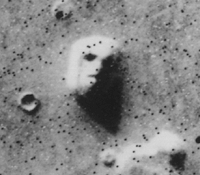
But when something that provocative lacks too much information,
it leaves everything else to the imagination. Books were written at that time,
loaded to the brim with whimsical but fascinating speculation about The Face on
Mars. In 2001, another orbiter, Mars
Global Surveyor promised another photo of the famous Face, this one
promising much higher resolution. A raw
photo was promised to be uploaded to the Mars Global Surveyor website as soon
as it was transmitted back to Earth, and a friend and I sat at the library
computer as the photo rolled in. That day I learned that definition and clarity, when applied to a mysterious and cloudy
revelation, kills faith.

Plenty of my brilliant friends were adherents of astrology,
tarot, and crystal vibrations. These
were not passing hobbies, but bordered on obsessions. Some of my friends had a shelf or two full of books on these
subjects, and held to their beliefs with uncritical devotion. I continued my fascination with Reiki, and
even though the mental source of its power was always obvious to me, I still
wondered if there was not something more to the powerful experiences that I
often felt. I remember one amazing
vision that I had during some meditation exercises. I floated high above the Cosmos, which slowly undulated under me
like an immense flag in the wind. I was
above the fabric of space-time. I was a
transcendent observer and could look from outside the fishbowl, just as if I
were part of the Divine. Then the
Cosmos became bigger, or I floated too close to it, until I was swallowed up
into it, and got lost in the immensity.
Had I been a religious ecstatic from another time, I can easily imagine
myself as Enoch traversing the Heavens and learning the secrets of the Cosmos
from the archangels.
Unlike the days when I was in Calvary Chapel, I did not
scoff at the beliefs or others, or try to convert them to my own beliefs. I was intrigued with Reiki, but I also asked
plenty of questions about the beliefs in things like astrology and
reincarnation. I found the answers
unsatisfactory, so I did not believe in such things. It was as simple as that.
But I had learned that if I was to be taken seriously, I had to take
others just as seriously, and it was just too easy to view the beliefs of
others as crazy.
I met one particular woman in one of my math classes, and we
began dating. After several months of
dating this beautiful and brilliant Chemistry PhD candidate, she felt she could
trust me enough to tell me a secret about herself. Her secret came out slowly, in bits and pieces, over the next
couple of weeks. I only knew her on the
material and physical realm of Earth, she told me. But on another plane of existence, she was a warrior
princess. She fought trolls and
monsters to protect her loyal subjects.
She could shoot fireballs of pure energy from the palms of her hands.
This was a bit much.
Was she kidding me? Was this a
stunt? Was Allen Funt going to step out
from behind the curtain with his hidden camera?
She also had a familiar guardian cat who served as her
psychic advisor.
I never ridiculed her.
Never. I had learned never to do
that. Instead, I asked her if I could
see. Since she trusted me enough to
tell me, could I see and experience the things she did?
“Can I see your familiar cat?”
“No. She is
invisible. But she is right there
watching you,” she said pointing to the floor.
“Can you take me to your other world? Can I see what you see? Can I travel there with you?”
“No. It is a place
that you do not travel to physically.
You only get there through the astral realm. You are not ready.”
I wanted to take her seriously. What if she is right after all?
It would be beyond fantastic! I
would be one who truly bore secret knowledge and my life would never again be
the same!” But too many things that I
asked about were invisible, or inaccessible, or beyond my understanding. I was convinced that she was experiencing something,
but if I were to continue to take her seriously, I would have to accept her by
Faith alone. I simply could not do
that, and I had to confess to myself that she was simply deluded. The experience of breaking up with her was
extremely painful. I felt like I had
been trusted, and that I had betrayed her trust. How could this intelligent, seemingly rational young woman hold
these beliefs? How could she cling to
these beliefs, and drop out of a University PhD program rather than face her
unbelieving, skeptical ex-boyfriend?
It was also around this time that I stumbled into James
Randi’s book The Faith Healers in the university library. Randi, a well-known stage magician and
professional investigator, detailed his personal investigations into the world of
Faith Healers. Some of his favorite
whipping boys were Peter Popoff, Ernest Angley and W. V. Grant. These men who posed as itinerant evangelists
were obvious conmen, who used stage tricks to magicians, to fool the needy into
tithing money into their personal savings.
It said nothing about belief in a True God, but about conmen posing as
God’s prophets, I reasoned. I had never
heard of Popoff or Grant, but I did hear of some of the other people in his
book. Oral Roberts was a well known
Faith Healer when I was a child, and my mom had even owned a copy of his book
on Seed Faith. If we tithed, it was a
sign to God of our faithfulness, and he would reward our planting of seed faith
many fold! That made perfect sense to me
as a youngster, and Roberts was revered as a devout and holy man of God! That childhood fantasy was shattered by The
Faith Healers, in which Randi exposed Robert’s bogus claims of various
miraculous cures and resurrections.
Katherine Kuhlman was another family favorite. My mom once saw her on the traveling tent revival circuit, and my
mom marveled that she saw Katherine Kuhlman lengthen a crippled man’s leg right
before her eyes! But Randi again showed
how W. V. Grant performed the same cheap stage illusion. Sure, I would not be fooled by such obvious
chicanery by cheap suits like Popoff and Angley, but I figured that was because
I had never heard of them before. I
knew Roberts, and I knew Kuhlman, both of whom were doing the work of God. Yet, Randi lumped these well known paragons
and models of my youth in with the rest of the crooks who lied and swindled in
the name of God. The Faith Healers was
did not affect my faith in Jesus, but it did make me suspect that most of the
preachers I knew in my youth were nothing but conmen. What shocked me that most was that my family was fooled by these
people. We were intelligent people, yet
we were fooled, and could be fooled again.
We did not know how to think critically. Nobody ever taught us. We
were just taught to have Faith.
We all have the propensity to be fooled if we do not
actively apply critical thinking skills.
I became friends with an elderly woman who was a retired music professor
from Canada. She moved to New Mexico
with her beloved dogs because she loved the solitude of the desert
southwest. But one of her dogs got very
sick, so she went to see a ‘healer’. I
noticed that my friends used the term ‘doctors’ for impersonal practitioners of
western medicine, but ‘healers’ were more empathic of their patient’s needs and
generally more non-traditional. A woman
certified in Reiki was a ‘healer’. So
when my elderly friend told me she was taking her beloved dog to a healer, I
knew it would not be the vet. After the
visit, she asked me to listen to a cassette.
“I know you are more skeptical than most, and you may think
I am crazy, but I want you to listen to this recording. I just need your opinion, because you are
skeptical and I don’t want to make the wrong decision.”
“What is the recording?”
“I recorded the session I had with my dog and an
inter-species translator. She placed
her hands on my dog, and told me the dog’s thoughts.”
Oh dear. This
intelligent, elderly woman, a retired professor who had traveled the globe, a
woman who told amazing stories of her work in Africa with Jane Goodall in the
1960s, this otherwise rational human, took her dog in for a Mr. Spock style
mindmeld. But I did not ridicule. I took her seriously. I took the cassette and listened to it on my
own.
What I heard was stunningly obvious manipulation. The healer said that the dog was
talking through her. He does not feel
good. He ate some road kill. He has an upset belly that will not go
away. He wants you to understand that
he will be better but he needs a more sensitive diet. My friend sometimes interjected with astonishment. How could the healer seemingly read the mind
of her dog? Incredible!!
I told her I thought she was being had. I advised her to proceed with caution, and
take the sick dog to a vet. I am
impressed that she listened to me. But
all these stories that I am telling boil down to one of the most important lessons that I learned while in university. Critical thinking is a
skill. It must be learned and actively
applied. It does not come naturally. Even the most intelligent of us, even
brilliant scientists and other educated people, can be fooled, in fact, are
likely to be fooled if our guard is not up.
And there were plenty of people out there who knew this, and were ready
to trick us into earning their trust, manipulating our emotions, and maybe even
draining our pocketbooks.
Previous Chapter
Next Chapter
